Capturing your invisible market
Capturing every single account you can sell to is the critical first step in building a revenue engine.
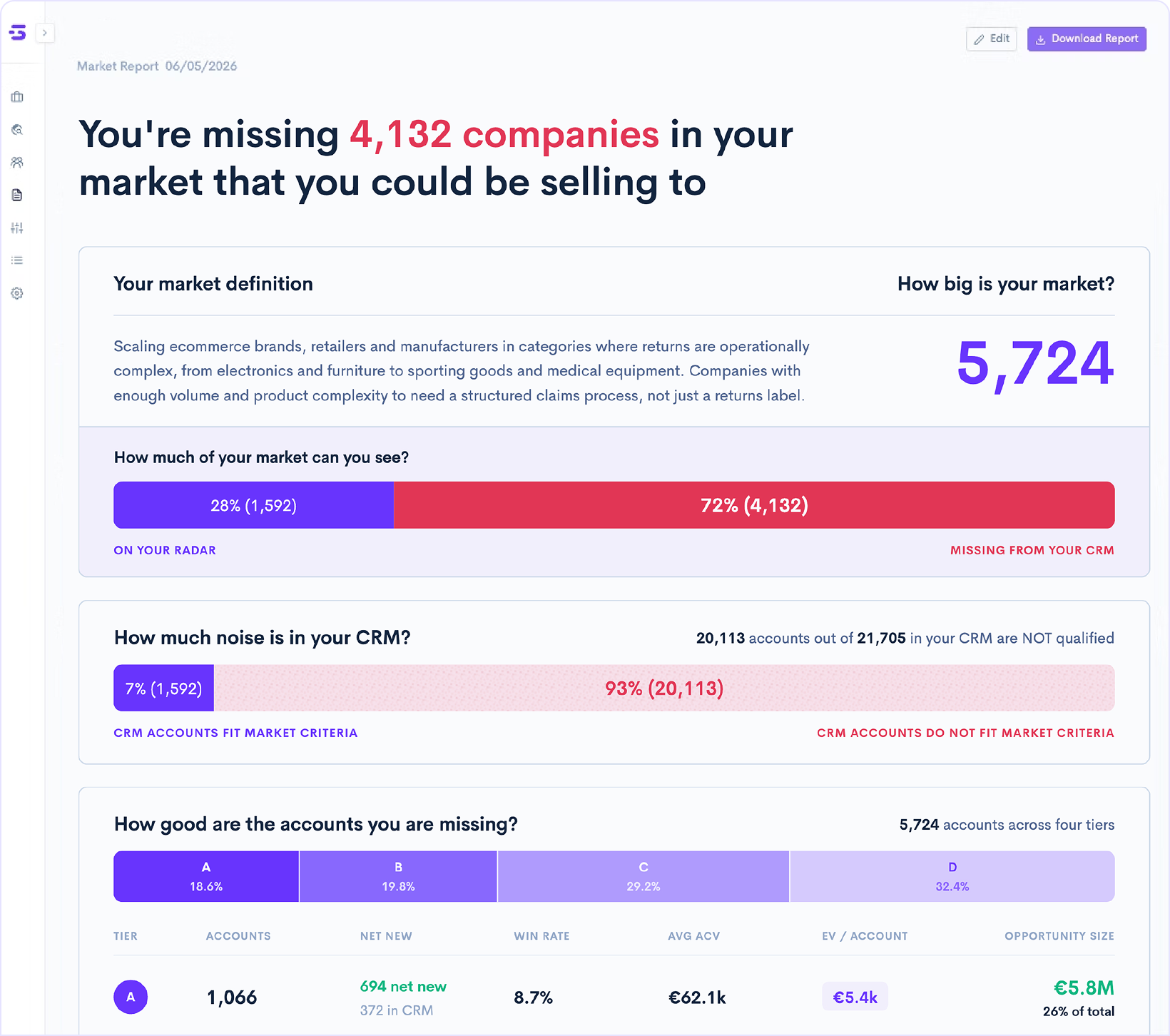
Download nowThe single biggest growth lever available to revenue leaders is not sales execution. It is gaining clarity on exactly what accounts to target. On average, B2B companies are missing 60% of the market they could sell to, while 70% of the accounts in their CRM don’t match who actually buys their product at all.
In “Capturing your invisible market”, we show you why that gap exists, what it’s costing you, and what to do about it.
Featuring real examples from top revenue teams, including Chili Piper, Merge, Playroll, and TrustKeith.
What’s inside
Find out why you’re missing 60% of your market, and what to do about it.
Most ICPs are built on proxy filters (headcount, industry, geography) that don’t capture the nuance of actual buyer profiles
The average B2B company is missing 60% of its market from their CRM
70% of accounts in the average B2B CRM are not real buyers
Classification models can capture qualified accounts at scale with the accuracy of a human reviewer
Many buyer profiles don’t exist as structured fields in any database
7% of a company’s addressable market changes every month
What is an “invisible market”?
How can I test my ICP definition to see if it is correct?
Why can’t we just use filters to find the right accounts?
I’ve mapped my market. Do I need to do it again?
See your true market
We’re currently offering a free market report.
We’ll define your actual ICP, size your market, and show how much of it you’ve captured (and how many accounts you’re wasting time on). Free, built for your business, in your hands within seven days.
Apply for your report here